Book a secure move

Background
Since 1994, the Prisoner Escort and Custody Services (PECS) contract has outsourced the secure transport of prisoners across England and Wales. It covers adults, children and young people moving to and from police stations, courts, prisons, secure training centres (STCs) and secure children’s homes (SCHs). On average, 622,000 moves take place each year, covering around 10.5 million miles.
I was hired as Senior Product Manager to lead development of Book a secure move, the digital service that would support the PECS Generation 4 contract.
The Generation 4 contract would also introduce an updated fleet of escort vehicles with enhanced safety and security features. These vehicles would supply Book a secure move with real-time data on the location of detainees and prisoners while they were being moved.
These changes would improve the efficiency of the PECS service, along with safety, security and decency for prisoners. Over the 10-year term of the contracts, the government would also realise significant benefits: fewer delays at court, an end to mixed transportation of adults and youths, and prisoners spending less time in court cells and prison vans.
I joined the programme team early in the bid phase, tasked with outlining and scoring digital requirements for potential transport suppliers.
Approach
The bid phase let me build my understanding of the PECS service quickly. I met a wide range of users and stakeholders across the programme, carried out early research and validated initial concepts for the service.
Suppliers had concerns about how to shape their digital proposals. Integration was a key one: the new contract required them to accept digital move requests and risk assessments. Under previous contracts, individual sites had sent spreadsheets to the transport supplier, and every other form was paper based and provided at the point of pickup. Reporting was limited as a result. The new contract was an opportunity to deliver real-time reporting, which would improve prisoner safety and identify operational efficiencies sooner.
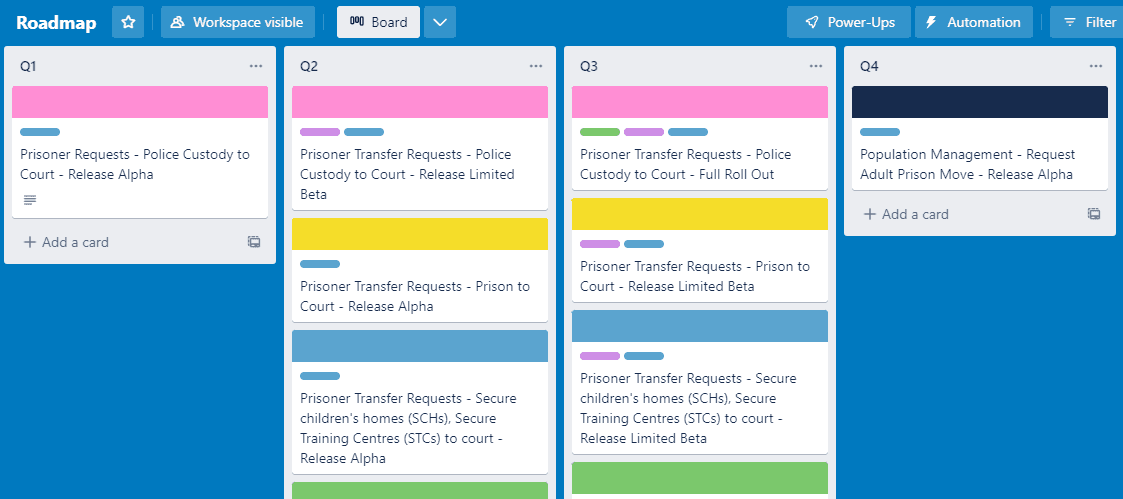
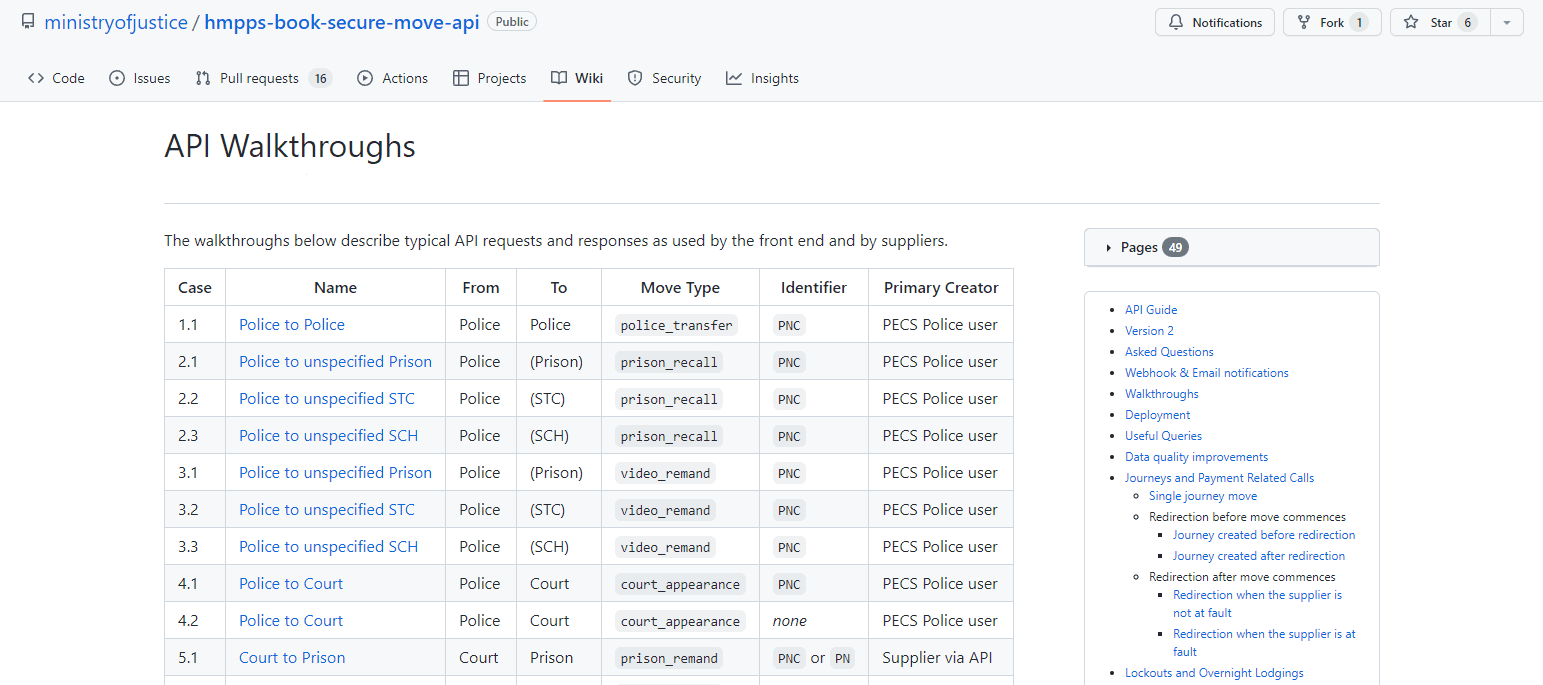
We published a high-level roadmap and a draft API specification for the service. These set out the timeline for each release and the collections and resources that would support it.
We adopted dual-track agile, which let us learn and iterate quickly. The service was complex, covering multiple business areas:
| Component | Book a secure move benefits |
|---|---|
| Move requests | Users can request moves and supply initial risk assessments through a single service rather than sending spreadsheets over email |
| Population management | Provides an overview of the current and projected prison population and enables single and bulk transfer requests between prisons, supported by prisoner profile search |
| Complex risk & medical assessments | Each move requires detailed assessments, which can be partially pre-filled from previous forms and other systems, saving significant time compared with completing paper forms |
| Handover | Final checks and confirmation for transfer of care |
| Events | Suppliers provide notifications of events that occur whilst a move is underway |
| Location | Suppliers provide GPS locations for vehicles, which improves safety and helps sending and receiving sites plan resources better |
| Billing & compliance data | Provides a single source of truth for move requests against authenticated HMPPS users, greatly reducing assurance workload (around 5,000 manually checked records a month) and enabling automated costing of moves |
The programme and digital teams worked closely together to identify key stakeholders and ensure appropriate governance was in place.
We formed squads around specific areas of the service, working alongside business change to build a shared understanding and develop relationships with stakeholders. We started with a small number of sites that were willing to take part in research and test alpha and beta versions of the service.
Rollout
The service rollout was complex, with:
- more than 25,000 users across 772 sites (prisons, police custody, the youth estate and courts)
- multiple cross-government stakeholders at site, regional and national level
- complex legislation, policies and overlapping processes
- an internal rollout to operational, assurance and finance teams
- operational concerns that required constant flexibility
Our initial focus was on move requests from police custody. As adoption grew across the business, so did confidence. Addressing issues quickly was a key factor in that. A number of sites mainly used the service in the early hours of the morning. This meant feedback at all hours, but it also helped us shape an appropriate post-live support model.
Suppliers were developing their own services in parallel, so integration assurance happened in stages, normally during the limited beta phase. We gave sites the ability to generate email-based move request summaries, ensuring continuity where integration assurance had not been finalised. Once suppliers were assured on the simple use cases, we moved on to the more complex ones.
Data
We identified key rollout metrics:
- for each site, the percentage of moves requested through the service rather than by email or phone
- for each site, the number of risk assessments started online, completed online or completed on paper
Whilst simple, these became good success indicators. Numbers varied by site, and that variation showed us where additional support or research was needed.
Over time we built a large number of reports to support compliance, providing insights that were previously unavailable or took substantial manual effort to produce.
Outcome
We rolled out Book a secure move to all 772 sites in under 15 months, overcoming numerous challenges, including Covid. At the time of rollout, the service achieved a 95% user satisfaction rating.
Suppliers have fully integrated with the service, and real-time data now provides valuable insights, transforming reporting, compliance and billing. Most importantly, the service has improved safety, security and decency for prisoners through better sharing of relevant risk information.
In 2021, the work won the MOJ Project Delivery function’s “Collaboration of the Year” and “Innovation of the Year” awards.
“Thank you for the excellent work, perseverance and superhuman effort seen across the teams to deliver the significant solutions and services which have been provided on behalf of the PECS Generation 4 Programme. The systems, engagement, supporting services and continued improvements that have been delivered to colleagues across the justice estate have proven to be not only well received, but also facilitating significant positive change in this environment.”